Neo-fascists in the United States and globally have playbooks describing how to take over democratically elected governments and create dictatorships. Mencius Moldberg, the cyber alias for Curtis Yarvin, wrote a 120,000 word Open Letter to Open-Minded Progressives in which he called for “the liquidation of democracy, the Constitution and the rule of law…” The new regime would sell off public schools, destroy universities, abolish the press, and imprison “decivilized populations,” as succinctly summarized by Ava Kofman in her excellent article Autocracy Now in the June 9, 2025 issue of the New Yorker. Yarvin is the strategy guru for the billionaire neo-fascist Peter Thiel, Vice President J.D. Vance and for Trump who seem to be following that playbook line by line.
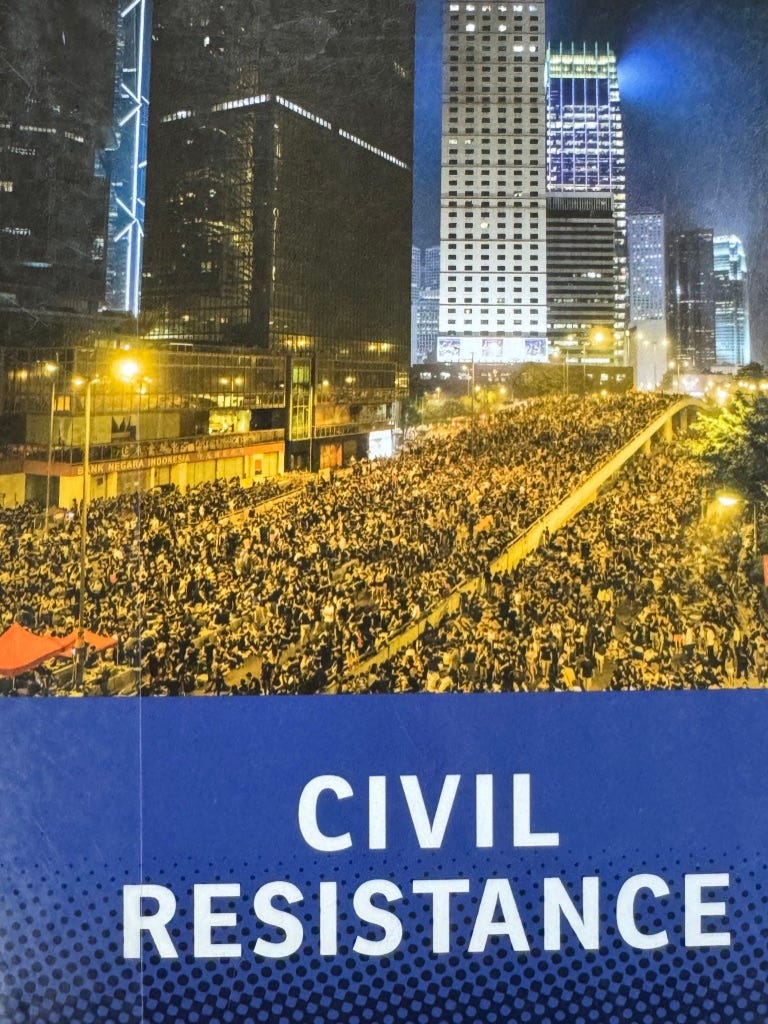
Erica Chenoweth, a professor of public policy at Harvard University’s Kennedy School has written an extraordinary book, Civil Resistance (Oxford University Press, 2021), which is defined as a form of struggle in which unarmed people coordinate a variety of actions to build power to force change.
Chenoweth would not likely call it a handbook to stop dictators, but it can be read that way. Among other things, Chenoweth studied 627 violent and non-violent revolutionary campaigns to end authoritarian regimes in the last 120 years. This Substack describes one of the important messages from Chenoweth’s research to stop a dictator:
Four lessons for civil resistance to succeed
1. Mass Participation drawing from all walks of life
“The single most important influence on a civil resistance campaign’s success is the scale and range of popular participation.” They argue that mass participation seriously disrupts the status quo. Ignoring a large-scale campaign becomes politically impossible. She gives the example of the large-scale participation in the Sudanese revolution of 2018-19 against Omar al Bashir.
2. Shifting Loyalties among the regime’s supporters
A key factor in a movement’s success is its ability to shift the loyalties of people within the adversaries’ pillars of support. These include women, youth, students, elderly, professionals, taxi drivers, merchants and small business owners, religious figures, civil servants and more.
Shifting the loyalties of people who support the regime often means hurting the wallets of key economic or business elites; threatening the business or professional interests of important military or security officials or simply sidelining powerful opponents within the regime. Reform minded elites begin to sense a shift in the political winds and see that it is in their interest to shift sides. Self-interest among elites is more often persuasive than moral arguments. They give the example of apartheid era South Africa, where white business owners ultimately began to support ending apartheid and pressured the South Africa government to negotiate with the ANC. This shift happened after black townships boycotted their goods, international corporations divested from the South Africa economy and international organizations imposed sanctions on the apartheid government.
3. Using a variety of tactics not just demonstrations
Movements that shift between a variety of tactics are more likely to succeed that movements that rely on a single tactic such as street demonstrations. Civil resistance includes a wide range of organized and coordinated activities outside of normal governmental channels—organized street demonstrations, strikes, a general strike, slowdowns, stay aways, boycotts, sit-ins, non-cooperation, street art, blockades, and creating alternative economic, political and social institutions. They give the example of the resistance of teachers in Nazi occupied Norway who successfully refused to teach if they were required to use a Nazi curriculum.
4. Having staying power which means cultivating resilience, maintaining discipline and having an organized leadership structure
Movements that achieve this staying power have clear organizational structures, succession plans in place for leaders and contingency plans for how to respond when repression comes. As in the case of the overthrow of Milosevic in Serbia, leaders of the resistance report that 95% of their effort went into planning, training, preparation and follow up; only 5% of their effort went into the actions themselves.
A take-away
One key take-away for me from Chenoweth’s Four Lessonsis we should be working on many fronts. Street demonstrations are important and it is good news that demonstrations are growing in number, size and participant diversity. But demonstrations alone will not bring a dictator down. There needs to be massive non-cooperation and resistance on many different fronts.
Some of that resistance is happening already which I will report on in future Substacks. I want to begin that exploration with Chenoweth’s enlightening take on the American Revolution. They write:
“American colonists waged a civil resistance campaign against British imperial rule from 1763 to 1775, before the Revolutionary War…[The] armed revolt didn’t happen until after an extended period of effective civil resistance that made it all but impossible for the British government to govern the American colonies. Methods included boycotts of British goods; refusal to consume British-made goods; noncooperation [with] laws requiring colonists to export raw materials from the American colonies to Britain; colonists mass refusals to serve on juries under Crown-appointed judges; destruction of Crown property, as in the Boston Tea Party, and the creation of parallel economic, judicial, and political institutions—including the Continental Congress itself… As John Adams wrote in a letter to Thomas Jefferson, ‘What do we mean by the revolution? The War? That was no part of the revolution; it was only an effect and a consequence of it. The revolution was in the minds of the people, and this was effected from 1760 to 1775, in the course of fifteen years, before a drop of blood was shed at Lexington. ‘” (page 14)
Chenoweth’s book, Civil Resistance presents a very hopeful analysis. The research shows that there have been more nonviolent revolutions over the past two decades alone than during the entire 20th century.
The book is also a cautionary tale. It describes the brutality of dictators. It describes the ways and reasons that civil resistance fails. And it shows that the odds of success for non-violent resistance is only 50-50; violent resistance succeed half as frequently. It is up to us to increase the odds of non-violent resistance succeeding in the United States.
Good news
Ice raids called off
Good news is busting out all over. Trump was pressured to call off the ICE raids of farm, hotel and restaurant workers. Pressure from the owners of those businesses and our support of immigrants, forced him once again to show the truth of his TACO epithet—Trump Always Chickens Out. And in yet another flip flop, The Washington Post on Monday reported that Trump changed his mind again and the raids of farm, hotel and restaurant workers are back on. Those businesses and their workers are being stabbed in the back. The contradictions are coming home to roost.
Cracks that let in the light
Christie Walton, an heiress of the Walmart fortune, according to the Wall Street Journal, has “broken ranks” and is part of the anti-Trump movement. She backed the Lincoln Project, supported an anti-Trump super PAC and funded the No Kings Day protest, placing a full-page add in the New York Times supporting the demonstrations.
No Kings demonstrations
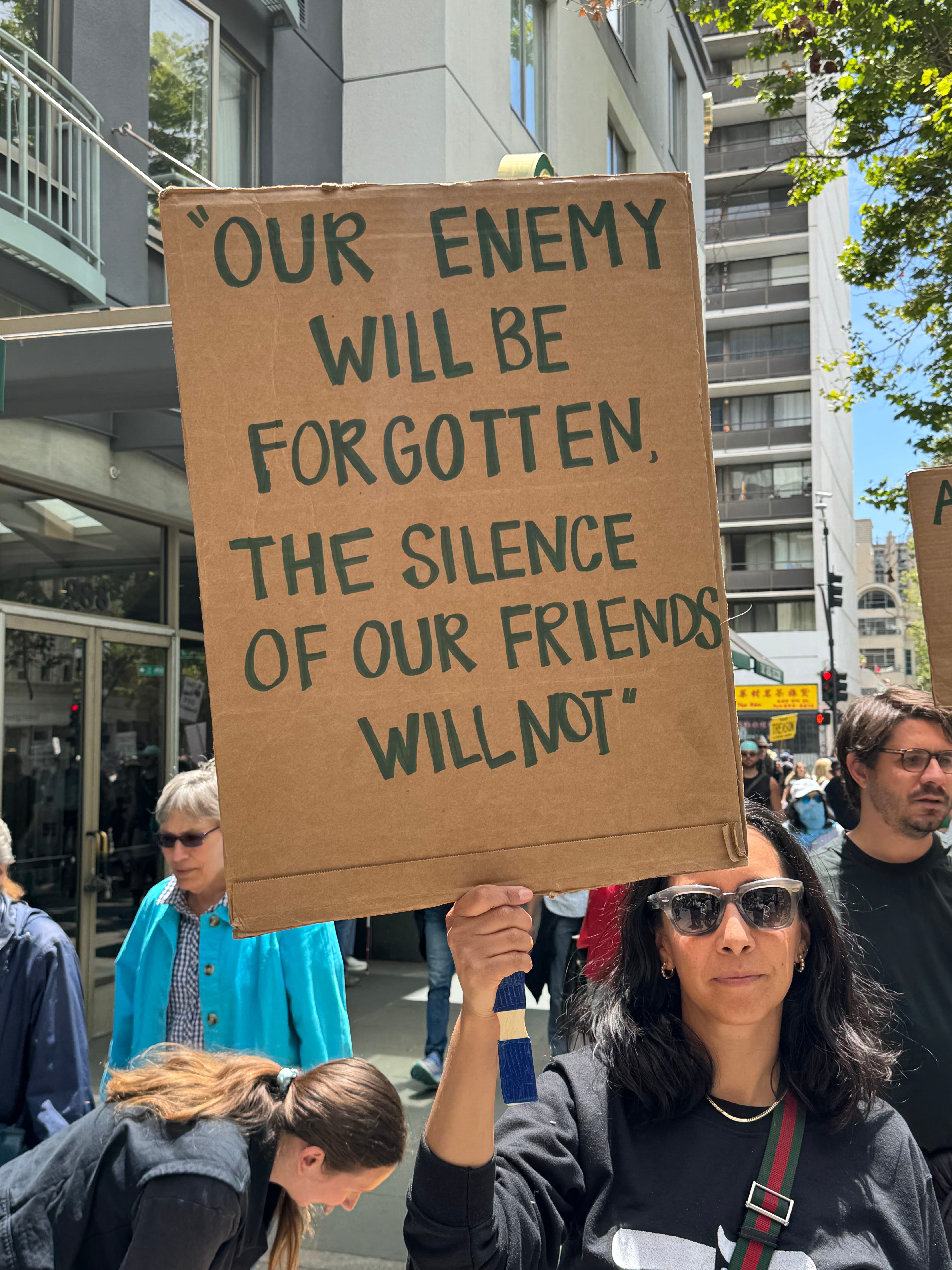
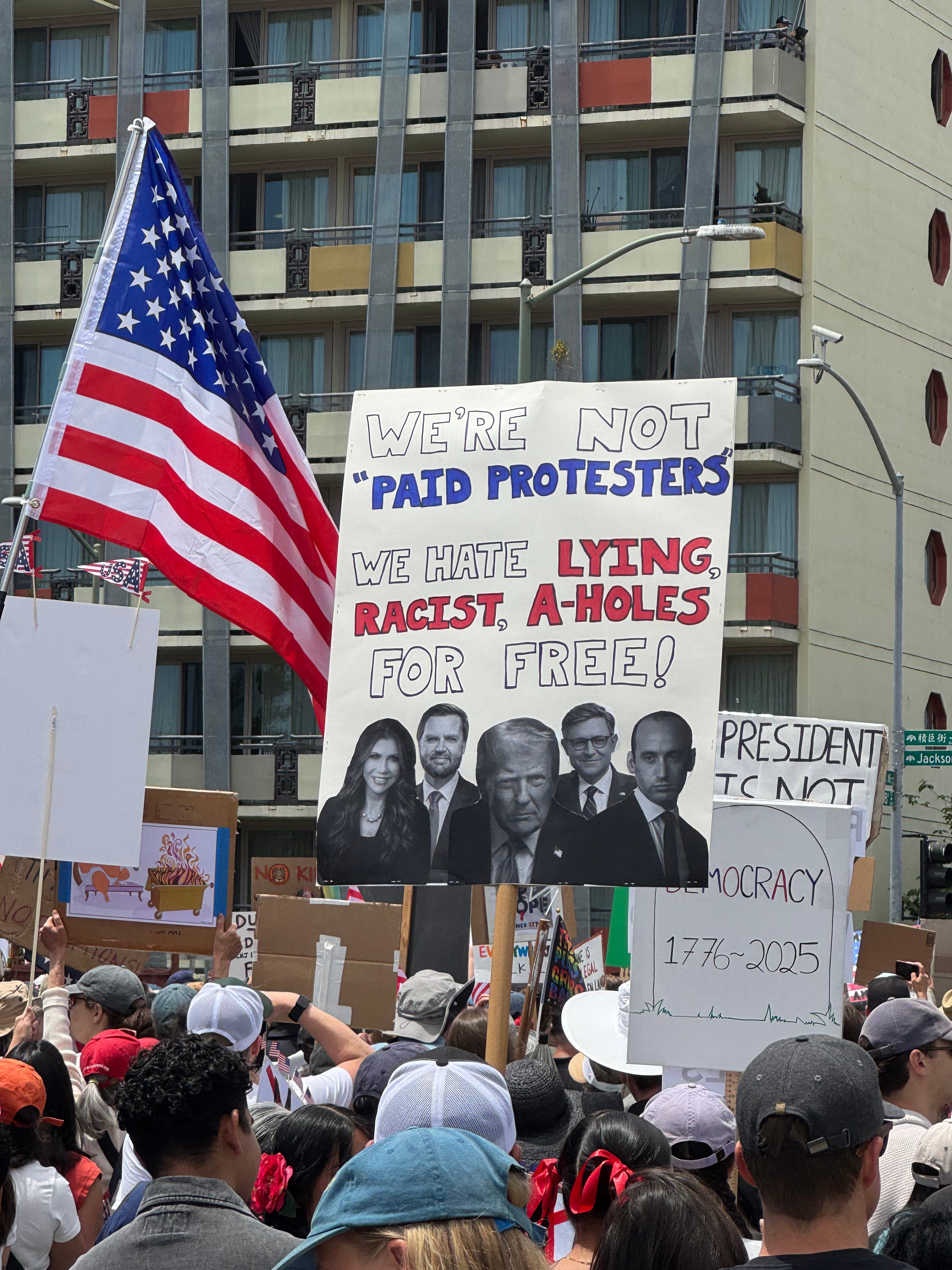
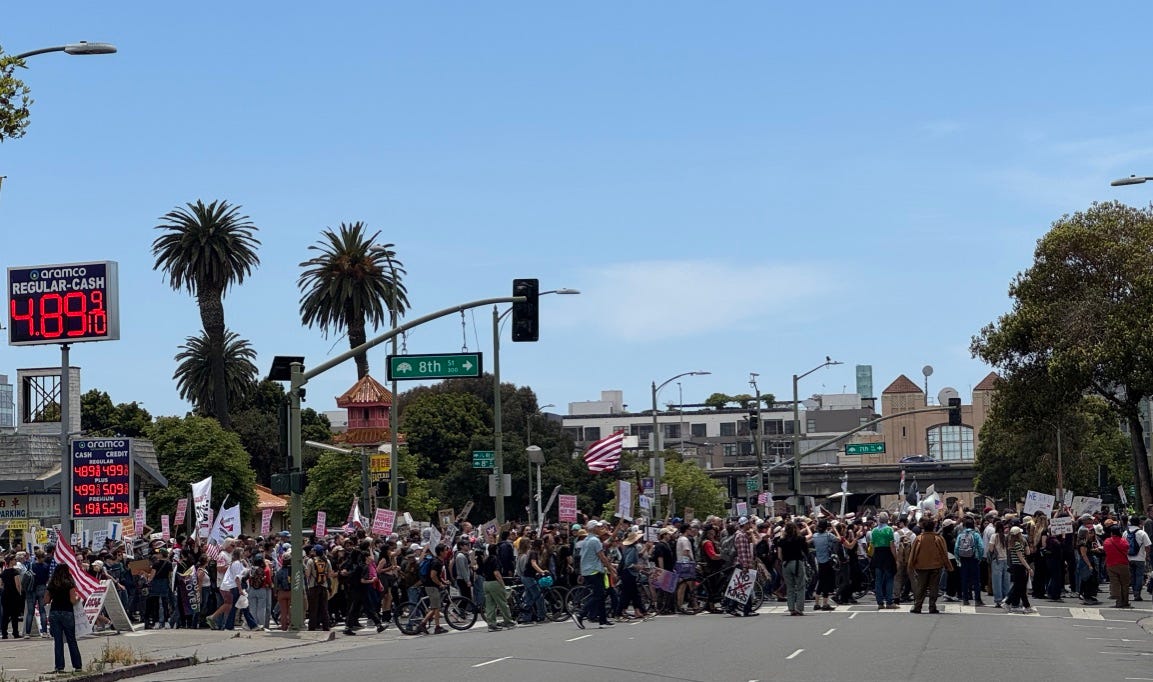
There were 2,169 demonstrations across the country for No Kings Day. Five million people were on the streets protesting—200,000 in NYC, 100,000 in Philadelphia, 50,000 in San Francisco and at least 10,000 here in Oakland. The photos at the end of this Substack show the signs and some of the energy of the day.
Pathetic support for Trump’s military parade
The crowds were small and the bleachers were mostly empty for Trump’s military parade. The contrast of the pathetic turnout for Trump’s parade with the millions of people on the streets protesting, showed how increasingly weak and feeble he is.
Don’t get too comfortable
Clark Kissinger was the National Secretary of Students for A Democratic Society in 1964-65. He has been a political activist throughout his life. He recently compared Trump’s illegally federalizing California’s National Guard in Los Angeles to what happened in Weimar Germany before Hitler was appointed Chancellor. In part he wrote:
“In Weimar Germany, Prussia was the state with the largest population and strongest opposition to the rising Nazi party. In short, it was the California of Germany. In order to break the power of Prussia, with its Social Democratic government, on July 20, 1932, using emergency powers German Chancellor Franz von Papen replaced the Prussian state government with a “Reich Commissioner” (namely himself) and transferred executive power to the Minister of Armed Forces, Gen. Kurt von Schleicher. According to Papen, this was done because ‘public safety and order in Prussia could no longer be guaranteed.’
The dissolution of the Prussian state government was an important step toward the appointment of Hitler as Chancellor, only six months later.
So how did the social democratic government of Prussia respond? They filed a law suit! And, of course, the courts found in the federal government’s favor. And how has Governor Gavin Newsom responded to Trump’s federalizing California’s National Guard and sending them into the streets against the people protesting ICE raids?…He has filed a law suit.”
Newsom to his credit called on the people of California to demonstrate on June 14th. He might have ordered government officials under his command not to cooperate with illegally deployed federal officials, but he didn’t. That is the kind of non-cooperation that has to happen to stop Trump.
No Kings demonstration in Oakland
People in Oakland marched from Wilma Chan Park to Frank Ogawa Plaza, a mile away. The streets from park to plaza were filled with demonstrators.
Unfortunately those ICE raids have not been called off. DHS announced yesterday that they have not changed anything regardless of what Trump may have said. Clearly Tv isn’t running things anymore. Miller is.
Dave, you have outdone yourself this time. Thanks for bringing together, and highlighting, key resources and insights in support of the massive resistance this existential moment demands. I plan to circulate your essay far and wide and I hope every reader does the same. Thanks!!





Unfortunately those ICE raids have not been called off. DHS announced yesterday that they have not changed anything regardless of what Trump may have said. Clearly Tv isn’t running things anymore. Miller is.
Dave, you have outdone yourself this time. Thanks for bringing together, and highlighting, key resources and insights in support of the massive resistance this existential moment demands. I plan to circulate your essay far and wide and I hope every reader does the same. Thanks!!